Discover Tahtib (also spelled Tahteeb)—an ancient Egyptian stick-fighting martial art from Upper Egypt that began as military training and later became a respected festival stick game. Learn Tahtib’s origins, how it was taught, who practiced it, what weapons it used, how it worked in war, and how Modern Tahtib keeps this Egyptian staff fighting tradition alive today.
What is Tahtib
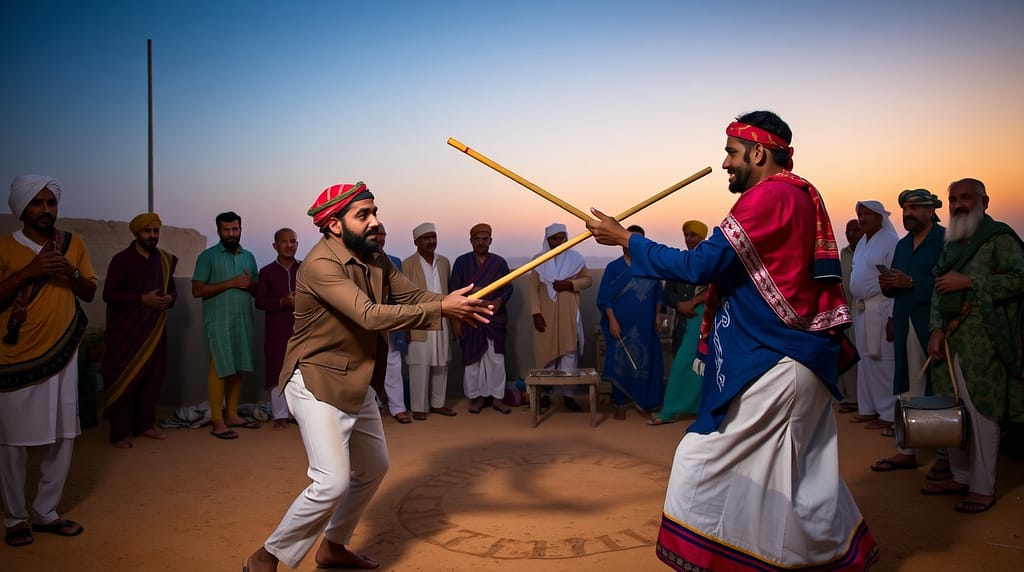
Tahtib is a traditional Egyptian stick fighting art—a mix of martial training, dueling skill, and later public performance. Today, you’ll often see it as a controlled “stick game” performed to music in celebrations, especially in Upper Egypt (Saeedi culture). In martial arts terms, think of it as an early “weapons dojo” built around one simple tool: the long staff/cane.
Origins: where it’s from and how old it is
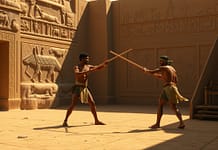
Tahtib’s roots go back deep into ancient Egypt. Archaeological depictions show stick-fighting or staff drills in Old Kingdom and later-era sites—often described as military training with sticks. One commonly cited early example is from the Pyramid complex of Sahure at Abusir (c. 2500 BCE), with later scenes appearing in other periods and places.
So when people call it one of the world’s oldest living staff traditions, that’s not marketing fluff—it’s tied to real historical depictions and continuity of practice in Egypt.
Earliest practitioners: who trained it first
Based on how it appears in historical sources, soldiers are a major early group associated with Tahtib as training—alongside other combat skills (like wrestling and archery in broader military prep discussions).
But Tahtib didn’t stay locked behind barracks gates. Over time it also became popular among ordinary people, especially in rural Upper Egypt, and moved into weddings, festivals, and community gatherings.
Why it was practiced
Tahtib served two big purposes:
- Martial purpose (ancient martial training)
- Timing, distance, footwork, and the ability to “read” an opponent
- Weapons conditioning and combat mindset
- A safer training stand-in for harsher battlefield tools
- Social purpose (festival honor game / community test)
- A public display of control, courage, and reputation
- A cultural performance tied to music and celebration
- A way to channel warrior energy into a rule-bound contest
What it consisted of (how Tahtib “fights”)
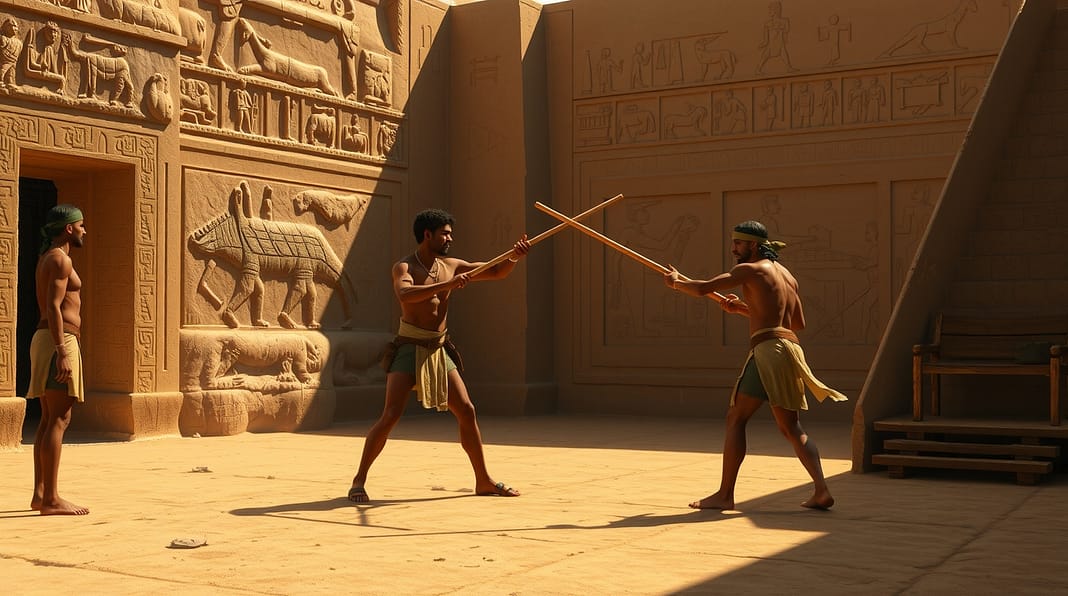
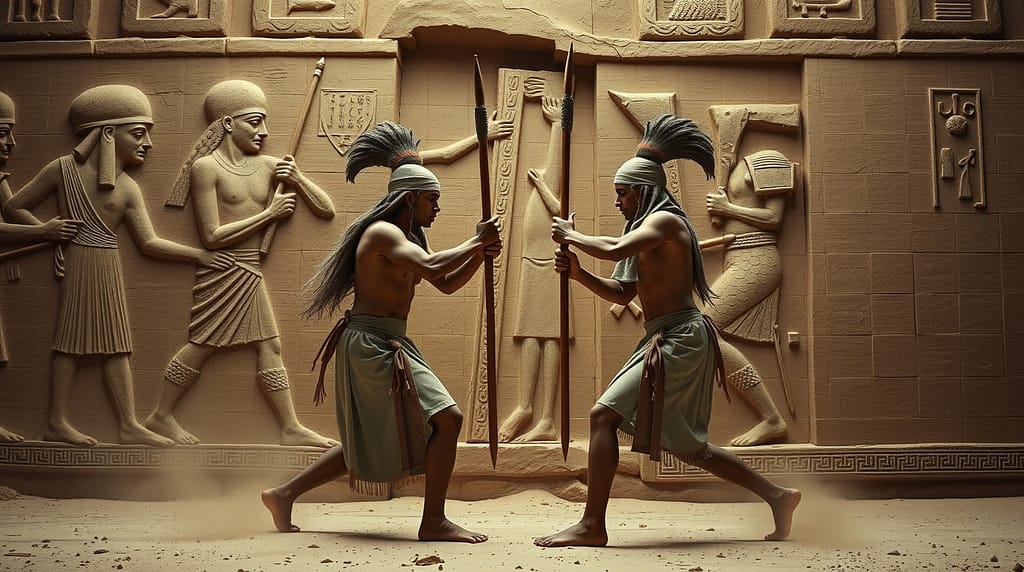
At its core, Tahtib is two opponents facing off with long sticks, testing each other with feints, angles, pressure, and dominance of the line.
In the UNESCO-listed festive form, it’s described as a brief, non-violent interchange in front of an audience, emphasizing complete control.
For a martial arts reader: Tahtib is not just “stick swinging.” It’s about:
- entering without getting tagged,
- controlling range,
- breaking rhythm,
- and making the other person hesitate.
Weapons used: what stick did they use?
The weapon is a long wooden stick/cane, commonly around four feet in many descriptions, with regional naming (often described as asa/asaya/assaya/nabboot depending on context).
Historically, the stick functions as:
- a training weapon,
- a dueling tool,
- and later a festival/game implement rather than a battlefield standard weapon.
How it was taught (and how people of different ages learned)
Traditional village transmission usually looks like “real martial arts” everywhere:
- watch first (kids and teens see it at weddings/festivals),
- copy the basics (stance, grip, stepping),
- then gradually spar under control once you can prove discipline.
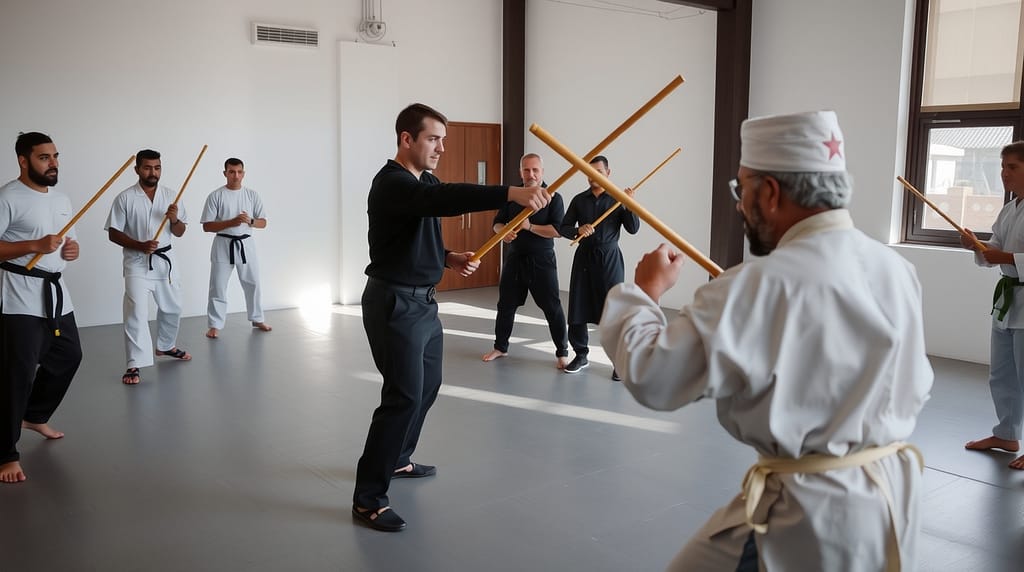
In modern codified systems (often called Modern Tahtib), teaching is formalized with structured methods, including forms/series and training progressions designed for wider audiences beyond village culture.
If all ages learned, the key is the stick itself: you can scale intensity. Beginners can train flow, coordination, and footwork before adding speed, pressure, and competitive timing.
Was it only for warriors/army, or did everyone use it?
It appears strongly tied to soldier training in ancient depictions, but it also became a popular community practice and celebration art over time.
So the best simple answer is:
It started “warrior-coded,” but it didn’t stay warrior-only. It became part of cultural life—especially in Upper Egypt.
Was it for males only?
In many traditional contexts, Tahtib is commonly described as performed by men at celebrations (especially in older descriptions of weddings and public games).
However, modern organizations explicitly teach Modern Tahtib for males and females, aiming to make the practice accessible as an educational/sportive method beyond Egypt as well.
Was Tahtib used in war?
Tahtib is widely described as having a role as martial training in ancient Egypt—so even if the stick wasn’t always the “main battlefield weapon,” the skill-building (timing, distancing, aggression control, weapon handling) absolutely supports war preparation.
Does it still exist today?
Yes—very much.
- Traditional Tahteeb/Tahtib is still practiced and performed in Upper Egypt as a cultural stick game.
- It was inscribed by UNESCO as “Tahteeb, stick game” on the Representative List of the Intangible Cultural Heritage of Humanity (inscribed in 2016).
- Modern Tahtib exists as a more codified, “martial arts class-friendly” approach with structured methods and training drills.
Health benefits (martial arts benefits, Tahtib style)
Tahtib training—especially when done with control—can build:
- shoulder and grip endurance (weapon handling),
- footwork stamina,
- spine/hip coordination (turning and tracking),
- timing and reaction speed,
- and the big one: focus + self-control under pressure (because losing control is losing the art).
In modern commentary on Modern Tahtib, practitioners also highlight learning, attention, and broader “martial arts” benefits amplified by rhythm and stick work.
Why Tahtib matters to martial artists today
If you’re a martial arts person, Tahtib hits a rare sweet spot:
- It’s ancient but not dead.
- It’s a weapons art that rewards skill over brutality.
- It teaches a warrior lesson many modern fighters forget: control is power.
And maybe the coolest part: Tahtib proves that a martial tradition can survive for thousands of years by evolving—moving from soldier training, to community honor game, to modern codified practice—without losing its core spirit.